
There are more AI platforms, AI apps and AI tools available than ever before.
Some are general-purpose AI assistants. Others specialise in writing, coding, research, marketing, sales, customer service, data analysis or automation. Newer platforms are also combining AI models, integrations and AI agents into broader business systems.
This creates a new problem.
How do you choose the right AI platform when there are so many options?
The answer is not necessarily to find the platform with the most features.
A better approach is to understand what your business needs, identify the type of AI software that fits those needs and evaluate each option using practical criteria such as usability, integrations, reliability, security, cost and potential business value.
This guide explains how to choose an AI platform and what businesses should consider before adopting AI software.
What Is an AI Platform?
An AI platform is software that provides access to one or more artificial intelligence capabilities through a single environment.
Depending on the platform, this may include:
- AI assistants
- Large language models
- AI applications
- AI agents
- Workflow automation
- Data analysis
- Content generation
- Business integrations
- APIs
- Knowledge management
Some platforms are designed primarily for individuals, while others are built for teams and businesses.
There is also an important difference between an AI model, an AI tool and an AI platform.
An AI model provides the underlying intelligence.
An AI tool uses AI to perform a particular task.
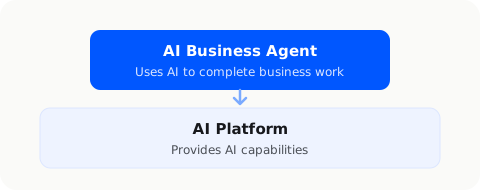
An AI platform can bring together multiple AI capabilities, tools, models, integrations or workflows in one environment.
The boundaries are becoming less rigid as AI products increasingly combine these capabilities.
Why Is Choosing an AI Platform Difficult?
The AI software market changes extremely quickly.

A platform that was considered innovative several months ago may now face competition from newer products with different models, features or workflows.
The same AI model can also be available through multiple products.
For example, a business may be able to access an AI model through:
- A general AI assistant
- An AI productivity suite
- A developer platform
- A workflow automation platform
- A specialised business application
This means the question should not simply be:
"Which AI model is the best?"
A more useful question is:
"Which AI platform best fits the work we need to accomplish?"
What Should You Look for in an AI Platform?
A useful AI platform evaluation should go beyond a feature checklist.
The following criteria can help businesses compare options.
1. Ease of Use
An AI platform can have sophisticated technology but still provide little value if employees find it difficult to use.
Consider:
- How quickly can a new user get started?
- Is the interface intuitive?
- Does it require technical knowledge?
- Can employees understand how to use the main features?
- Is there documentation or training available?
Ease of use matters particularly for small businesses because there may not be a dedicated AI specialist responsible for implementation.
2. Use Case Fit
The best AI platform is highly dependent on what you actually want to accomplish.
A platform designed for coding may be excellent for developers but unnecessary for a company looking for customer service automation.
Similarly, a general AI assistant may be useful for writing and research but may not provide the workflow capabilities required for business operations.
Start with the problem rather than the product.
For example:
Problem: Employees spend too much time processing documents.
Possible solution:
AI document processing platform
Or:
Problem: Salespeople spend too much time updating CRM records.
Possible solution:
AI CRM or sales automation platform
The use case should determine the category of software you evaluate.
3. AI Capabilities
Different platforms provide different levels of AI functionality.
Consider whether you need:
- Text generation
- Document analysis
- Image generation
- Voice processing
- Data analysis
- AI search
- AI agents
- Workflow automation
- Multi-step task execution
For simple writing and research, a general AI assistant may be sufficient.
For more complex workflows, a platform with AI agents and integrations may be more appropriate.
Current AI platforms increasingly combine models with automation and agent capabilities rather than limiting themselves to chat-based interactions. Gumloop's current AI-app guide, for example, distinguishes general AI applications from platforms that connect AI models with APIs and automated workflows.
4. Integrations
An AI platform rarely operates in isolation.
Businesses already use software for:
- CRM
- Accounting
- Project management
- Communication
- Documents
- Storage
- E-commerce
- Marketing
An AI platform becomes more useful when it can work with the systems already in use.
Check whether the platform supports the applications your business depends on.
Also consider whether integrations allow the AI to:
- Read information
- Write information
- Trigger workflows
- Update records
- Send notifications
- Perform actions
An AI tool that produces excellent answers but cannot access the information needed for the task may have limited practical value.
5. Output Quality
AI output quality should be evaluated against the actual task.
For example, when testing a writing platform, consider:
- Accuracy
- Clarity
- Consistency
- Tone
- Editing required
For an automation platform, consider:
- Whether workflows complete correctly
- How the system handles unexpected inputs
- How often human intervention is required
- Whether actions are executed reliably
The important question is not whether the AI looks impressive in a demonstration.
It is whether it performs reliably on your actual work.
6. Reliability
Reliability becomes increasingly important when AI is used for business processes.
A tool that occasionally produces a poor blog draft may be inconvenient.
A system that incorrectly updates financial or customer information can create a much more serious problem.
When evaluating an AI platform, consider:
- System availability
- Error handling
- Consistency
- Human review options
- Auditability
- Support
- Recovery processes
AI should not be treated as automatically reliable simply because it is powered by a sophisticated model.
7. Security and Data Privacy
Businesses may use AI with sensitive information.
This can include:
- Customer information
- Financial data
- Internal documents
- Contracts
- Sales information
- Employee information
- Business strategy
Before adopting an AI platform, understand:
- How data is stored
- How data is processed
- Who can access it
- Whether data is used to train models
- What security controls are available
- Whether permissions can be managed by user or team
The appropriate security requirements will vary depending on the business and the type of information being processed.
8. Pricing
AI software can use many different pricing models.
For example:
- Free
- Per user
- Monthly subscription
- Usage-based
- Credit-based
- API usage
- Enterprise pricing
Do not compare prices based only on the monthly subscription.
Consider the total cost of using the platform.
A cheaper tool may require significant manual work.
A more expensive platform may save substantial employee time.
The relevant calculation is:
Software cost vs value created
rather than:
Lowest subscription price = best choice
Current AI app comparisons increasingly consider pricing alongside actual usefulness, integrations and continued usage rather than treating price as the only deciding factor.
9. Scalability
An AI tool that works for one person may not necessarily work for a 50-person organisation.
Businesses should consider whether the platform can scale in terms of:
- Users
- Data
- Usage
- Integrations
- Permissions
- Administration
- Workflows
A small business may start with a single user but eventually need team collaboration and administrative controls.
Choosing software that has a clear path to expansion can reduce the need to replace it later.
10. Product Development
AI software is changing quickly.
A platform should not be evaluated only on its current feature list.
Consider whether the product is actively improving.
Questions to ask include:
- Is the platform regularly updated?
- Are new AI models supported?
- Are integrations being added?
- Is the company actively developing the product?
- Does the roadmap match your future needs?
The AI market is evolving rapidly, so product development can be an important part of long-term value.
Best AI Platform vs Best AI Tool
These terms are often used interchangeably, but they can represent different things.
AI tool
An AI tool is often designed for a particular job.
Examples include:
- AI writing tools
- AI image generators
- AI meeting tools
- AI transcription tools
- AI research tools
AI platform
An AI platform may provide multiple capabilities in one environment.
It might combine:
- AI models
- Applications
- Integrations
- Data
- Automation
- AI agents
A business should therefore decide whether it needs a specialised tool or a broader platform.
If the problem is narrow, a specialised AI tool may be sufficient.
If the business needs multiple AI capabilities connected to existing workflows, a broader platform may make more sense.
Best AI Platform for Business vs Best AI Platform for Individuals
The requirements can be different.
An individual may primarily care about:
- Ease of use
- Quality
- Price
- Speed
- Personal productivity
A business may additionally need:
- Team collaboration
- Security
- Access controls
- Integrations
- Data management
- Administration
- Reliability
- Scalability
This is why an AI application that works extremely well for an individual may not necessarily be appropriate as the main AI platform for a business.
AI Platforms for Small Businesses
Small businesses often face a different set of constraints from large enterprises.
They may have:
- Smaller budgets
- Smaller teams
- Less technical expertise
- Fewer IT resources
- More limited implementation capacity
This makes simplicity particularly important.
A small business may not need an extremely complex enterprise AI platform.
Instead, it may benefit more from software that solves a specific operational problem without requiring a large implementation project.
The goal should be to find the right level of technology for the business.
Should a Business Use One AI Platform?
Not necessarily.

There is no requirement for a company to use one AI platform for everything.
A business could use:
- One AI assistant for general research
- One AI tool for meetings
- One specialised marketing application
- One CRM platform
- One business operations system
The important issue is whether the systems work together effectively.
Using too many disconnected tools can create another problem: employees have to switch between applications and information becomes fragmented.
On the other hand, forcing every business function into one platform may mean compromising on functionality.
The right balance depends on the organisation.
AI Platform vs AI Automation Platform
Another important distinction is between a general AI platform and an AI automation platform.
A general AI platform may focus on:
- Chat
- Research
- Writing
- Data analysis
- Content generation
An AI automation platform focuses more on:
- Workflows
- Integrations
- Triggers
- Actions
- AI agents
- Multi-step processes
For example:
AI platform
"Analyse this sales report."
AI automation platform
"When a new sales report arrives, analyse it, identify unusual changes, create a summary and send it to the sales team."
The second example involves an ongoing workflow rather than a single interaction.
How to Compare AI Platforms
A simple comparison framework can help businesses avoid choosing software based purely on popularity.
| Criteria | Questions to ask |
|---|---|
| Use case | Does it solve the problem we actually have? |
| Ease of use | Can employees learn it quickly? |
| AI capabilities | Does it provide the AI functionality we need? |
| Integrations | Does it connect to our existing software? |
| Output quality | Is the result good enough for real work? |
| Reliability | Can we depend on it consistently? |
| Security | Can we safely use our business data? |
| Pricing | Does the value justify the cost? |
| Scalability | Can it support us as we grow? |
| Product development | Is the platform continuing to improve? |
This type of framework is more useful than simply asking which platform has the most features.
How to Calculate Whether an AI Platform Is Worth It
Businesses can estimate the potential value using a simple calculation.
Suppose an employee spends:
10 hours per week on a repetitive process.
If an AI platform reduces that to:
4 hours per week
the business saves:
6 hours per week
Over a year, that is approximately:
312 hours
The business can then compare the value of those saved hours with the annual software cost.
This is not a perfect ROI calculation because quality, risk and employee experience also matter.
But it provides a useful starting point.
The same approach can be applied to:
- Reduced processing time
- Reduced manual errors
- Faster customer response
- Increased sales capacity
- Lower administrative workload
Should AI Replace Existing Software?
Not necessarily.

AI does not always require replacing existing systems.
In many cases, the better approach is to add AI capabilities around the tools a business already uses.
For example:
Existing CRM + AI
can improve sales research and follow-up.
Existing document system + AI
can improve document search and summarisation.
Existing finance workflow + AI
can reduce manual data processing.
This is why integrations are such an important part of evaluating AI software.
How to Start Choosing an AI Platform
A practical selection process can be relatively simple.
Step 1: Define the problem
Do not start with:
"We need an AI platform."
Start with:
"Our employees spend too much time doing X."
Step 2: Define the desired outcome
Decide what improvement would make the investment worthwhile.
Step 3: Identify the required AI capabilities
Determine whether you need an assistant, specialised AI tool, automation platform, AI agent or broader business platform.
Step 4: Shortlist several options
Compare products against the same criteria.
Step 5: Test them with real work
Use actual but appropriately controlled business scenarios rather than relying only on product demonstrations.
Step 6: Measure the results
Compare:
- Time
- Cost
- Quality
- Reliability
- Employee experience
Step 7: Expand after validation
Once the platform demonstrates value in one workflow, consider additional use cases.
Where InstantFlow AI Fits
InstantFlow AI sits closer to the AI business operations category than a general-purpose AI chatbot.
It is designed for solo founders and small businesses that need to manage recurring operational work such as:
- Expenses
- Receipts
- Quotes
- Invoices
- Transactions
- Cash flow
- Back-office operations
This creates a different use case from a general AI assistant.
A general AI assistant might help a business owner write an email or analyse a document.
An AI business operations platform is designed to help manage recurring operational processes.
For a small business evaluating AI software, the relevant question is therefore not simply:
"Which AI platform is the best?"
It is:
"Which AI platform or tool is best suited to the business problem I need to solve?"
For some businesses, that may mean a general AI assistant.
For others, it may mean a specialised AI application.
For businesses looking to reduce repetitive operational work, an AI business operations platform such as InstantFlow AI may be more relevant.
The AI Platform Landscape Is Changing
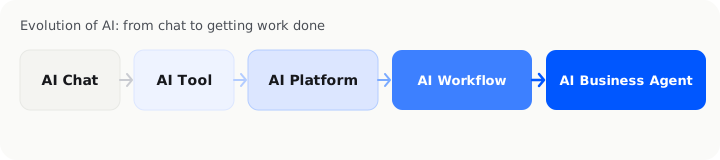
AI software is moving from standalone applications towards increasingly connected ecosystems.
A modern AI platform may combine:
- Multiple AI models
- AI applications
- Business data
- Integrations
- Automation
- AI agents
- Human review
This means the traditional distinction between an AI app, AI tool and AI platform is becoming less clear.
The technology will continue to change.
The underlying selection principle, however, remains relatively stable:
Choose technology based on the business problem, not simply the popularity of the technology.
Frequently Asked Questions
What is the best AI platform?
There is no single AI platform that is best for every business or user. The appropriate choice depends on the required use case, AI capabilities, integrations, security, pricing, reliability and scalability.
What should I look for in an AI platform?
Consider ease of use, use-case fit, AI capabilities, integrations, output quality, reliability, security, pricing, scalability and continued product development.
What is the difference between an AI platform and an AI tool?
An AI tool is often designed for a particular task, while an AI platform may combine multiple AI capabilities, models, applications, integrations or workflows in one environment. The distinction varies between products.
How do I choose an AI platform for my business?
Start by identifying a specific business problem. Define the desired outcome, determine which AI capabilities are required, compare several platforms, test them with real work and measure the results before expanding adoption.
Should small businesses use AI platforms?
AI platforms can be useful for small businesses when they solve a meaningful business problem without creating unnecessary complexity. Ease of use, cost, integrations and scalability are particularly important considerations.
Is the most expensive AI platform the best?
Not necessarily. The value of an AI platform depends on how well it solves the business problem and how much measurable value it creates relative to its cost.
Conclusion
Choosing an AI platform is becoming more difficult because the number of AI applications, tools and platforms continues to grow.
The answer is not to find the platform with the largest number of features.
Instead, start with the business problem.
Understand what work needs to improve, determine which AI capabilities are required and evaluate platforms based on usability, integrations, output quality, reliability, security, pricing and scalability.
An AI platform should ultimately earn its place in the business because it makes meaningful work easier, faster or more effective.
For small businesses, that may mean starting with a general AI assistant.
For another company, it may mean a specialised AI tool.
And for businesses looking to connect AI with recurring operational processes, an AI business operations platform may be the more relevant category.
The best AI platform is therefore not necessarily the platform with the most capabilities.
It is the one that fits the work your business actually needs to do.

Michael Tang · Digital Content Manager
Focused on digital content, AI tools and enterprise technology trends, researching and distilling practical information that turns complex technology and AI applications into clear, accessible content for business owners and professionals.