Artificial intelligence has moved beyond being a technology used mainly by developers and large technology companies. Today, businesses of all sizes can use AI tools to write content, analyse information, communicate with customers, manage workflows, automate repetitive tasks and support everyday operations.
But with thousands of AI tools available, choosing the right one can be difficult.
Some AI tools are designed for writing and research. Others focus on productivity, marketing, sales, customer service, finance, data analysis or workflow automation. Newer AI agents can go further by taking actions and completing multi-step tasks instead of simply generating an answer.
This guide explains the main types of AI tools for business, what they can be used for, and how businesses can decide which tools are worth adopting in 2026.
What Are AI Tools for Business?
AI tools for business are software applications that use artificial intelligence to help people perform tasks, analyse information or automate business processes.

They can range from general-purpose AI assistants that help with writing and research to specialised software designed for sales, customer service, marketing, finance or operations.
For example, a business might use AI to:
- Draft emails, proposals and documents
- Summarise meetings and conversations
- Analyse spreadsheets and business data
- Create marketing content
- Answer common customer questions
- Research markets and competitors
- Manage sales leads
- Process repetitive administrative work
- Automate workflows between different applications
- Support finance and accounting processes
- Build AI-powered business agents
The important distinction is that an AI tool does not necessarily need to automate an entire business process. Some tools simply help a person complete individual tasks faster, while others can connect multiple steps into an automated workflow.
Why Are Businesses Using AI Tools?
The main reason businesses adopt AI is not simply to use new technology. It is to solve specific problems.
Small businesses and lean teams often have limited time and resources. Owners may be responsible for sales, marketing, customer service, administration and operations at the same time.
AI can help by taking care of repetitive work and giving people more time to focus on activities that require judgment, relationships and decision-making.
Common benefits include:
Saving time
AI can reduce the amount of manual work involved in writing, research, data processing and administration.
Improving productivity
Employees can use AI to create first drafts, summarise information, analyse data and complete routine tasks more quickly.
Reducing repetitive work
Tasks such as data entry, document processing, customer responses and workflow updates can potentially be automated.
Supporting better decisions
AI tools can help organise large amounts of information and identify patterns that may otherwise take considerable time to analyse.
Scaling small teams
A small business can use AI software to increase its output without necessarily increasing headcount at the same rate.
AI should generally be viewed as a way to augment people rather than as a universal replacement for human judgment. Businesses still need people to verify important information, make decisions and manage relationships.
The Main Categories of AI Tools for Business
There is no single AI tool that is best for every business.
The right choice depends on what the business is trying to accomplish. A useful way to understand the AI software landscape is to divide tools into several categories.
1. AI Assistants
General-purpose AI assistants can help with a wide variety of everyday tasks.
They can be used for:
- Writing and editing
- Brainstorming
- Research
- Summarisation
- Translation
- Document analysis
- Planning
- Data analysis
- Creating first drafts
These tools are often a good starting point for businesses that are new to AI because they can be applied to many different types of work.
However, they usually require a person to provide instructions, review the result and take the next action.
2. AI Productivity Tools
AI productivity tools focus on helping individuals and teams work more efficiently.
Common applications include:
- Meeting transcription
- Meeting summaries
- Email assistance
- Document management
- Task management
- Note-taking
- Knowledge management
- Project management
Instead of creating a completely new workflow, these tools often add AI capabilities to software a business already uses.
This can make adoption easier because employees can use AI within familiar applications.
3. AI Writing and Content Tools
Content is one of the most common business applications of generative AI.
Businesses can use AI writing tools to help create:
- Blog articles
- Website copy
- Product descriptions
- Email campaigns
- Social media posts
- Sales materials
- Proposals
- Internal documents
AI can significantly speed up the first-draft process, but human review remains important for accuracy, brand voice and originality.
4. AI Marketing Tools
AI marketing software can support activities such as:
- Content creation
- Audience research
- Campaign planning
- Personalisation
- Social media management
- SEO research
- Advertising
- Customer segmentation
For small businesses, the value is often in reducing the amount of manual work required to maintain consistent marketing activity.
5. AI Sales Tools
AI is also being used throughout the sales process.
Depending on the software, AI sales tools can help with:
- Lead research
- Lead qualification
- CRM updates
- Sales emails
- Meeting summaries
- Sales forecasting
- Customer research
- Follow-up tasks
Some newer AI sales systems can also act as agents that communicate with prospects or perform actions inside a CRM.
6. AI Customer Service Tools
Customer service is another area where AI can reduce repetitive work.
AI customer service software can help businesses:
- Answer frequently asked questions
- Route customer enquiries
- Summarise conversations
- Draft responses
- Search support documentation
- Provide support outside normal business hours
Businesses should still determine which questions can be safely handled by AI and which situations require a human employee.
7. AI Finance and Accounting Tools
AI is increasingly being applied to finance and administrative processes.
Potential applications include:
- Expense management
- Receipt processing
- Invoice processing
- Transaction recording
- Financial data organisation
- Cash-flow monitoring
- Document extraction
- Financial reporting
These applications can be particularly useful for small businesses because finance and administration often contain large amounts of repetitive work.
However, financial information is sensitive, so businesses should pay close attention to security, data handling and verification requirements when selecting software.
8. AI Workflow Automation Tools
AI workflow automation tools connect different applications and automate sequences of tasks.
For example:
Customer submits a form → information is analysed → CRM record is created → sales team is notified → follow-up email is prepared.
Traditional automation usually follows predefined rules.
AI-powered automation can introduce more flexibility by interpreting text, making decisions based on context and handling less structured information.
This is one reason AI agents are becoming an important part of business software.
9. AI Agents
AI agents represent a further step beyond traditional AI assistants.
An assistant may answer:
"What happened with this customer?"
An AI agent may be able to:
Find the customer record → analyse the conversation → identify the required action → update the CRM → prepare a response.
The exact capabilities depend on the software and the permissions given to the agent.
The key difference is that AI agents can potentially reason through multiple steps and take actions rather than simply producing text.
This makes them particularly relevant to business operations and workflow automation.
AI Tools by Business Function
Instead of searching for one universal "best AI tool", businesses can start by identifying the function they want to improve.

| Business function | Common AI applications |
|---|---|
| Productivity | Writing, research, summarisation, meetings |
| Marketing | Content, SEO, social media, campaigns |
| Sales | Lead research, CRM, outreach, forecasting |
| Customer service | Chatbots, support, response drafting |
| Finance | Expenses, receipts, invoices, transactions |
| Operations | Workflow automation, data processing |
| HR | Recruitment, onboarding, employee support |
| Data | Analysis, reporting, forecasting |
| Content | Writing, images, video, audio |
| Administration | Documents, scheduling, repetitive tasks |
This approach is often more useful than choosing software based purely on popularity.
What Are the Best AI Tools for Small Businesses?
For a small business, the most useful AI tool is usually the one that solves an important operational problem without introducing unnecessary complexity.
For example, a business that spends hours answering repetitive emails may benefit more from an AI communication tool than from an advanced AI image generator.
Similarly, a business spending significant time entering expenses and organising receipts may benefit more from AI-powered finance automation.
When evaluating AI tools, consider:
The problem being solved
Start with the task that consumes the most time or creates the most friction.
Ease of adoption
A powerful tool is less useful if employees cannot use it effectively.
Integration
Look for software that works with the systems the business already uses.
Security and privacy
Understand how business data is stored, processed and protected.
Cost
Consider the total cost rather than simply the advertised subscription price.
Human oversight
Determine which tasks require human review before information is sent, recorded or acted upon.
Scalability
A tool should ideally remain useful as the business grows.
These considerations are also reflected across current business AI guides: ease of use, integration, efficiency, affordability and the ability to fit into existing workflows are recurring selection criteria.
Free AI Tools vs Paid AI Tools
Many AI tools offer free plans or trials, making it relatively easy for businesses to experiment.
Free AI tools can be useful for:
- Testing a new workflow
- Writing and brainstorming
- Basic research
- Small-scale content creation
- Learning how AI can help a team
Paid tools may become more useful when a business needs:
- Higher usage limits
- Team collaboration
- Business integrations
- Automation
- Advanced security controls
- Larger data capacity
- More specialised features
The cheapest tool is not necessarily the most cost-effective option. A tool that saves several hours of work every week may provide substantially more value than a free tool that only handles occasional tasks.
How Should a Business Start Using AI?
Businesses do not need to automate everything at once.
A practical starting point is to identify one repetitive process.
For example:
Step 1: Identify a bottleneck
Find a task that consumes significant time every week.
Step 2: Measure the current process
Understand how much time, money or manual effort the process requires.
Step 3: Find an appropriate AI tool
Choose software specifically suited to the problem.
Step 4: Run a small test
Use the tool on a limited workflow before introducing it across the business.
Step 5: Measure the result
Compare time saved, output quality, cost and employee experience.
Step 6: Expand only when it works
Once a workflow produces measurable value, consider applying AI to another business process.
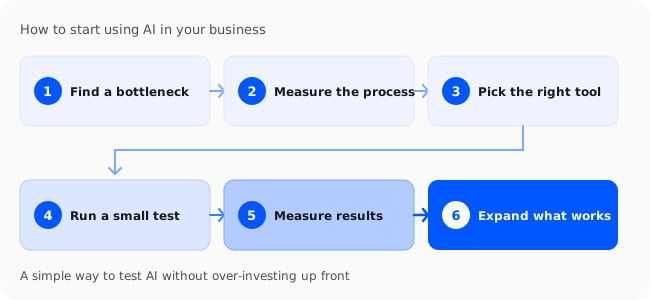
This approach reduces the risk of purchasing multiple AI tools without a clear purpose.
From AI Tools to AI-Powered Business Operations
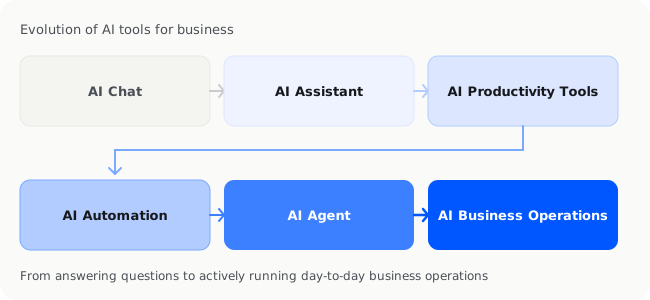
The AI market is gradually moving from individual tools towards connected systems.
Instead of having separate software for writing, customer communication, finance, sales and administration, businesses can increasingly connect these functions through automation and AI agents.
For example, an AI-powered business system could potentially help a small company manage information across:
- Customer enquiries
- Sales activities
- Quotes and invoices
- Expenses
- Transactions
- Administrative tasks
- Business reporting
This is where AI business software and AI business agents become different from simple AI assistants.
The goal is not only to generate information. It is to help the business complete work.
InstantFlow AI for Business Operations
InstantFlow AI is designed around this broader business-operations use case.
It is an AI-powered business operations platform for solo founders and small businesses, with a focus on helping businesses manage areas such as expenses, quotes, invoices, cash flow and back-office operations.
Instead of treating every task as a separate application, the idea is to use AI to simplify recurring operational work in one connected environment.
For a small business owner who is already using AI assistants for writing and research, an AI business operations platform can address a different part of the workflow: the administrative work that needs to happen after the customer interaction.
This makes AI tools complementary rather than interchangeable.
A business might use one AI assistant for research, another tool for marketing, and an AI business operations platform for everyday administrative and financial workflows.
The Future of AI Tools for Business
AI software is moving from simple content generation towards more integrated business automation.
The next generation of business AI will increasingly involve software that can understand context, connect to business systems and execute multiple steps.
This does not mean every company needs a fully autonomous AI workforce.
For most businesses, the practical opportunity is simpler: identify repetitive work, use AI where it creates measurable value, and keep people involved wherever judgment, accountability or relationships matter.
The best AI strategy is therefore not about collecting the largest number of AI tools.
It is about finding the right tools for the right problems.
Frequently Asked Questions
What are the best AI tools for business?
There is no single AI tool that is best for every business. The right choice depends on the business function, such as productivity, marketing, sales, customer service, finance or operations. Businesses should start with their most important workflow problem and select software designed to address it.
What are the best AI tools for small businesses?
Small businesses can consider AI assistants, productivity software, marketing tools, CRM and sales software, customer service platforms, finance tools and workflow automation software. Ease of use, integration, cost and security are particularly important when evaluating AI tools.
What can AI tools do for a business?
AI tools can help with writing, research, data analysis, customer communication, marketing, sales, finance, administration and workflow automation. More advanced AI agents can also perform multi-step tasks and interact with other business systems.
Are there free AI tools for business?
Yes. Many AI products provide free plans or trials. Free tools can be useful for testing individual use cases, while paid software may provide additional integrations, automation, usage capacity, collaboration features or business controls.
How should a small business start using AI?
Start with one repetitive, time-consuming process. Choose an AI tool that addresses that specific problem, test it on a small scale, measure the results and expand only after the workflow demonstrates value.
Conclusion
AI tools are becoming part of everyday business software.
From AI assistants and productivity tools to marketing, sales, customer service, finance and AI agents, there are now solutions for almost every area of business operations.
The challenge is no longer simply finding an AI tool.
It is identifying which business problem should be solved first.
For businesses starting their AI journey, the most practical approach is to begin with one repetitive workflow, measure the results and gradually build an AI-enabled operating environment around the processes that create the most value.

Michael Tang · Digital Content Manager
Focused on digital content, AI tools and enterprise technology trends, researching and distilling practical information that turns complex technology and AI applications into clear, accessible content for business owners and professionals.