
AI is no longer limited to individual chatbots and standalone applications.
Businesses can now access AI through productivity software, specialised applications, automation platforms, AI agents and broader AI platforms that bring multiple capabilities together.
This creates some confusion.
What exactly is an AI platform?
How is an AI platform different from an AI tool or AI model?
And how can businesses use AI platforms in practical day-to-day operations?
This guide explains the different layers of the AI ecosystem, how AI platforms work, the main types of AI platforms available and how businesses can use them.
What Is an AI Platform?
An AI platform is a software environment that provides access to one or more artificial intelligence capabilities.
Depending on the platform, it may provide:
- AI models
- AI assistants
- AI applications
- AI agents
- Workflow automation
- Data analysis
- Business integrations
- Knowledge management
- APIs
- Development tools
The exact definition varies between products.
Some AI platforms are designed for developers who want to build applications using AI models.
Others are designed for businesses and provide ready-to-use AI applications, automation and agents.
There are also platforms that combine several of these capabilities.
This is why the term AI platform can refer to quite different types of software.
AI Platform vs AI Tool vs AI Model
One of the easiest ways to understand the AI ecosystem is to separate three concepts.
AI Model
An AI model provides the underlying intelligence.
It can process information and generate outputs such as text, images, audio or analysis.
Examples include large language models and other specialised machine-learning models.
The model itself is generally not the complete business application.
AI Tool
An AI tool uses AI to perform a particular task.
Examples include:
- AI writing tools
- AI meeting assistants
- AI image generators
- AI transcription tools
- AI research tools
- AI presentation tools
An AI tool is usually focused on a specific user problem.
AI Platform
An AI platform can bring together multiple AI capabilities, models, applications, integrations or workflows.
For example, an AI platform might provide:
AI model + business data + integrations + workflow automation + AI agents
The boundaries between these categories are becoming less distinct as software companies increasingly combine models, tools and automation.
Why Are AI Platforms Becoming More Important?
Businesses often start their AI journey with individual applications.
An employee may first use an AI writing tool.
Then the marketing team adopts an AI content application.
The sales team starts using AI within its CRM.
The finance team introduces AI-assisted document processing.
Eventually, the business may have several AI applications operating independently.
This can create another problem:
AI becomes fragmented across the organisation.
Different tools may have different interfaces, data sources, permissions and workflows.
AI platforms attempt to address some of this fragmentation by bringing multiple capabilities together.
Instead of treating every AI use case as a separate application, businesses can build a more connected AI environment.
The Main Types of AI Platforms
Not every AI platform serves the same purpose.
Understanding the different categories makes it easier to identify which type is relevant to a particular business.
1. General AI Platforms
General AI platforms provide broad AI capabilities for tasks such as:
- Writing
- Research
- Brainstorming
- Summarisation
- Analysis
- Translation
- Document work
These platforms are often used as general-purpose AI assistants.
They can be useful when employees need support across many different types of work.
2. AI Development Platforms
AI development platforms are designed for developers and technical teams building AI applications.
They may provide:
- Access to AI models
- APIs
- Development tools
- Model management
- Data processing
- Application infrastructure
- Testing and monitoring
These platforms are useful when a business wants to build its own AI-powered application rather than simply use an existing AI product.
3. AI Productivity Platforms
AI productivity platforms integrate AI into everyday workplace activities.
They can support:
- Documents
- Meetings
- Spreadsheets
- Presentations
- Collaboration
- Search
- Knowledge management
The main objective is to improve how employees perform their existing work.
4. AI Automation Platforms
AI automation platforms focus on connecting AI with business workflows.
They can combine:
- Triggers
- AI models
- Business applications
- APIs
- Data
- Actions
- Workflow logic
For example:
New customer enquiry → AI analyses the request → customer is classified → CRM is updated → appropriate workflow is triggered.
The AI is therefore part of an ongoing process rather than being used for a single interaction.
5. AI Agent Platforms
AI agent platforms focus on systems that can perform multi-step tasks.
An AI agent may be able to:
- Understand a goal
- Gather relevant information
- Decide what needs to happen
- Use connected tools
- Perform actions
- Check results
- Escalate when human input is required
The capabilities vary considerably between platforms.
Some agents may only perform limited actions, while others can interact with several business systems.
6. Business AI Platforms
Business AI platforms are designed around specific business functions rather than AI capabilities alone.
They may focus on:
- Sales
- Marketing
- Customer service
- Finance
- Human resources
- Operations
- Administration
The advantage is that the platform already understands a particular business context and workflow.
AI Models vs AI Platforms
The relationship between an AI model and an AI platform can be compared to the relationship between an engine and a vehicle.
The model provides an important underlying capability.
The platform provides the environment through which that capability can be used.
A business may therefore use the same underlying AI model through different applications or platforms.
What changes is the surrounding experience:
- User interface
- Business data
- Integrations
- Workflow
- Permissions
- Automation
- Available actions
This is why businesses should not evaluate AI platforms based only on which AI model they use.
The surrounding software can be just as important.
What Can Businesses Do With AI Platforms?
AI platforms can support many different business activities.
Productivity
AI can help employees write, research, summarise and analyse information.
Customer service
AI can classify enquiries, search knowledge bases, draft responses and route requests.
Sales
AI can assist with lead research, CRM updates, sales communications and follow-ups.
Marketing
AI can support content creation, campaign planning, customer segmentation and analysis.
Finance
AI can assist with expenses, receipts, invoices, transaction records and financial information.
Operations
AI can connect business information and automate repetitive operational processes.
Administration
AI can process documents, organise information and reduce repetitive data entry.
The important point is that AI platforms can potentially connect these activities rather than treating every task as an isolated use case.
AI Platforms and Business Data
One of the biggest differences between a general AI application and a business AI platform is access to context.
A general AI assistant may know how to write a customer email.
A business AI platform may also have access to:
- Customer information
- Previous interactions
- Sales records
- Business documents
- Financial information
- Internal knowledge
- Operational workflows
This context can make AI more useful for business-specific tasks.
However, access to business data also creates additional security and governance requirements.
Businesses need to understand what information the platform can access and what actions it is allowed to perform.
AI Platforms and Integrations
Integrations are an important part of an AI platform.
Businesses already rely on software such as:
- CRM systems
- Accounting software
- Cloud storage
- Project management tools
- Communication platforms
- E-commerce platforms
- Databases
An AI platform becomes more useful when it can work with these systems.
For example:
CRM → AI platform → analysis → workflow → email → CRM update
Without integrations, employees may still need to manually move information between systems.
With appropriate integrations, AI can become part of the workflow itself.
AI Platforms and AI Agents
AI agents are becoming increasingly important within AI platforms.
Traditional software generally waits for users to perform actions.
An AI agent can potentially take a goal and determine a sequence of actions.
For example:
"Find all overdue customer invoices and prepare follow-up actions."
Depending on the platform, an AI agent could potentially:
- Search invoice records
- Identify overdue accounts
- Gather customer information
- Prioritise cases
- Draft follow-up messages
- Update records
- Request human approval
The exact capabilities depend on the permissions, integrations and agent design.
This is why AI agent platforms should be evaluated based on what they can actually access and execute rather than simply whether they use the term "agent."
AI Platforms for Small Businesses
AI platforms are not only relevant to large enterprises.
Small businesses can also benefit from AI platforms, particularly when a small team needs to handle many different responsibilities.
A business owner may be responsible for:
- Sales
- Customer service
- Finance
- Administration
- Marketing
- Operations
Instead of hiring separate people for every operational task, businesses can increasingly use software to support and automate parts of these workflows.
This does not mean AI replaces every employee.
Rather, it can give a small team additional operational capacity.
AI Platforms and Business Automation
AI platforms become particularly useful when they move beyond generating information and begin interacting with business processes.

Consider a simple example.
Without workflow automation
A customer sends an enquiry.
An employee:
- Reads the message
- Identifies the request
- Searches the customer record
- Updates the CRM
- Writes a response
- Creates a follow-up task
With AI-enabled workflow
The system can potentially:
- Receive the enquiry
- Understand the request
- Retrieve relevant information
- Update the customer record
- Prepare a response
- Create the follow-up task
The employee can then review or approve the appropriate steps.
This is where AI platforms start to connect with business automation.
AI Platforms and Security
The more business information an AI platform can access, the more important security becomes.
Businesses should consider:
Data access
What information can the platform access?
User permissions
Can different employees have different access levels?
Data storage
Where is business information stored?
Model training
Is business data used to train AI models?
Auditability
Can the business see what actions the AI has taken?
Human approval
Can important actions require approval before execution?
These considerations become particularly important when AI is used with financial, customer or confidential information.
AI Platform Costs
AI platforms can use several pricing models.
Common approaches include:
- Free plans
- Per-user subscriptions
- Usage-based pricing
- Credit systems
- API charges
- Enterprise plans
The right pricing model depends on how the platform will be used.
A business should consider both direct and indirect costs.
For example:
Direct cost
Monthly software subscription.
Indirect cost
Implementation, employee training, integrations and ongoing management.
The potential benefit should also be considered.
If an AI platform reduces hundreds of hours of repetitive work, its value may be significantly greater than its subscription cost.
AI Platform vs Multiple AI Tools
A business does not necessarily need an AI platform.
Sometimes several specialised AI tools are the better solution.
For example:
- A dedicated AI design application
- A specialised meeting assistant
- An AI CRM
- A finance automation platform
Each may perform its specific function extremely well.
An AI platform becomes more attractive when a business wants to connect several AI capabilities, business systems or workflows.
The decision therefore depends on the organisation's needs.
How Should a Business Choose an AI Platform?
The selection process should begin with the business problem.
Ask:
What are we trying to improve?
Then determine:
Which AI capability do we actually need?
Possible answers include:
- AI assistant
- AI productivity platform
- AI application
- AI automation platform
- AI agent
- Business AI platform
From there, evaluate:
- Use-case fit
- Ease of use
- Integrations
- Security
- Output quality
- Reliability
- Pricing
- Scalability
This approach prevents businesses from adopting an AI platform simply because it is popular.
For a more detailed evaluation framework, see our guide on how to choose the best AI platform for business.
AI Platforms and the Future of Business Software
Business software is gradually moving from static applications towards intelligent systems.
Traditional software primarily waits for users to tell it what to do.
AI-enabled software can increasingly:
- Understand information
- Predict what may be needed
- Recommend actions
- Generate content
- Automate workflows
- Take actions through connected systems
This does not mean traditional software will disappear.
Instead, AI is increasingly becoming a layer across existing business software.
The future may therefore involve fewer isolated AI applications and more connected AI capabilities embedded directly into business workflows.
Where InstantFlow AI Fits
InstantFlow AI sits within the AI business operations category.
It is designed for solo founders and small businesses that need to manage recurring business operations such as:
- Expenses
- Receipts
- Quotes
- Invoices
- Transactions
- Cash flow
- Back-office operations
The focus is not simply on providing a general AI chatbot.
It is on applying AI to recurring operational work.
This makes it an example of how an AI platform can move from general AI assistance towards business-specific workflows.
A business may use a general AI platform for research and writing while using an AI business operations platform for financial and administrative processes.
The two categories can therefore complement each other.
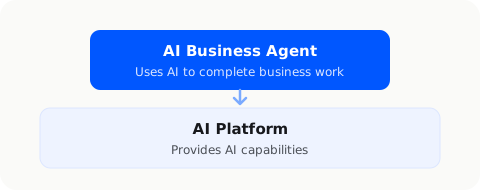
The Evolution of AI Platforms
The AI ecosystem can be viewed as a progression:
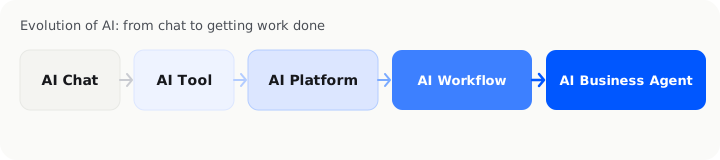
These categories are not completely separate.
A modern AI product may contain several layers at the same time.
What matters for businesses is understanding which layer solves the problem they actually have.
Frequently Asked Questions
What is an AI platform?
An AI platform is a software environment that provides access to one or more AI capabilities. Depending on the platform, it may include AI models, applications, agents, automation, integrations, data tools and APIs.
What is the difference between an AI platform and an AI tool?
An AI tool is usually designed to perform a particular task, while an AI platform can provide multiple AI capabilities, integrations, workflows or applications within a broader environment.
What is the difference between an AI platform and an AI model?
An AI model provides the underlying artificial intelligence capability. An AI platform provides an environment through which models can be used with applications, data, integrations, workflows or other services.
What can AI platforms be used for?
AI platforms can support productivity, research, marketing, sales, customer service, finance, data analysis, workflow automation and business operations. The exact capabilities depend on the platform.
Are AI platforms useful for small businesses?
Yes. AI platforms can help small businesses access multiple AI capabilities and automate recurring work without requiring a large technical team. The appropriate platform depends on the business's needs and available resources.
Are AI platforms secure for business use?
Security depends on the specific platform and how it handles data. Businesses should evaluate data storage, access controls, permissions, model training policies, integrations and auditability before using AI with sensitive information.
Conclusion
AI platforms are becoming an increasingly important layer of modern business software.
They can bring together AI models, applications, data, integrations, automation and AI agents in ways that allow businesses to move beyond isolated AI tools.
For individuals, an AI platform may provide a convenient way to access multiple capabilities.
For businesses, the bigger opportunity is connecting AI with real workflows and business information.
The most important question is therefore not simply:
"What is the most advanced AI platform?"
It is:
"What AI capabilities does my business need, and how should they connect to the work we already do?"
Understanding that distinction makes it easier to move from experimenting with AI tools to building a practical AI-enabled business environment.

Michael Tang · Digital Content Manager
Focused on digital content, AI tools and enterprise technology trends, researching and distilling practical information that turns complex technology and AI applications into clear, accessible content for business owners and professionals.